Most people struggle with their phone use. The main reason for this is the habits we’ve developed over many years of using social media, messaging, and news apps on our phones. 99% of the time we reach for our phone and unlock it out of habit. To check the X, Instagram or LinkedIn feed. Not because we have chosen to do so, just because our habit leads us to do so. I truly believe this is a major reason why most of us can no longer think clearly and work deeply. The cheap dopamine is calling 24/7 and is always available within half a second via Face ID.
The easiest way to minimize phone use is not only to delete all the distracting apps, but more importantly to disable Face ID and fingerprint unlock and replace it with a long password. That way, every time you pick up your phone, you have to enter a long password before you can use it. It could take you 20 seconds to type it. Enough time to check your intentions and realize that you don’t really want to use your phone.
Try it and your unwanted screen time will drop significantly.
As our world becomes more high-tech and AI-powered, our natural desire to connect with others will become even more intense. We’re wired to be social animals, always looking for social bonds and moments to share. Our human nature craves that connection.
As the typical office (for example) becomes less relevant, where will people meet and socialize in the future?
I think hotels will play a much more central and important role in the future – as they have in the past.
In the past, before I was born, hotels were like the heartbeat of cities, bringing people together. They weren’t just for travelers. They were these bustling hubs where locals and visitors mingled, where events were held and connections were made. It was like a meeting place where stories, cultures, and experiences collided, creating this vibrant tapestry of interactions beyond just a place to sleep.
Today, hotels have basically been downgraded to a place where travelers only go when they need a place to sleep. Even though most hotels have a restaurant and bar open to everyone, they are not used as such.
Hotels should take advantage of this potential and start to re-create this meeting and melting point for locals and travelers. A large hotel lobby with a bar, café, and restaurant. Co-working spaces, meeting rooms and even a large gym – available to everyone, not just guests.
Most hotels market themselves exclusively to travelers, missing out on the potential of being THE social hotspot in a neighborhood, which will only become more important in an automated and AI-driven world.
There are many values, qualities, and virtues that we look up to. Most of us try to live ethical and morally correct lives. In business, we try to build a great culture where everyone feels welcome and challenged. We all try to be kind, compassionate, and loving to those around us. But no matter what value, quality or virtue we’re talking about, I’ve learned that we should all be very critical of those individuals or organizations that shout the loudest.
I have found that the people who use the word ethical the most are usually the ones who are the most unethical. Business people who talk the loudest about how trustworthy they are usually end up betraying you. Companies that talk the most about innovation tend to be the least innovative. Political parties that talk the loudest about saving the planet or helping the poor usually end up doing the opposite.
Ethical people don’t need to advertise that they’re ethical – they just are. Trustworthy people don’t think about being trustworthy because they don’t know the concept of betrayal. The most innovative companies don’t need to talk about it – they let the results speak for themselves. Political parties help the poor and save the planet by doing the right things – not by talking about them.
When someone is unusually vocal about something – watch out.
The future will be drastic. Either we will see abundance or we might find ourselves in total chaos.
On the one hand, we see technological advancement such as artificial intelligence which in and of itself will lead to further exponential technological advancements. For example, researchers closest to AI research and development predict AGI might arrive in as little as 3 years. AGI which refers to artificial general intelligence or in other words artificial intelligence that is capable of doing any intellectual task that humans can perform.
The arrival of AGI could lead to groundbreaking advancements across diverse fields, potentially solving complex global challenges, enhancing human capabilities, and propelling society into a new era of prosperity and knowledge.
On the other hand, however, unchecked AGI also poses existential risks, where unintended consequences or malicious use might result in catastrophic outcomes, challenging the very fabric of human society and control. And that might turn out even worse than the current global geopolitical landscape where the deep state of the United States challenges an ever more mighty OPEC+ – with Europe incapacitated.
Overall, negative news spread faster and wider. Exponential advancements with and through AGI are not understood by the majority of people.
If we get artificial intelligence right, we might find ourselves in a world of abundance. If we fail to achieve or regulate it – chaos will persist.
Tomorrow I’ll be flying to Munich for three meetings. I’ll be meeting a partner of me, the seller of a very exciting business, and a potential business partner.
In theory, all of this could be done through a video call. In reality not so much.
While video calls are great for efficiently working through some relevant points, they are awful for building human relationships.
Video and phone calls often work great for the initial contact. They also work to efficiently discuss through relevant points to get some work done. But to build relationships, video calls simply don’t work.
Shaking hands, sharing a laughter, having a coffee or beer, meeting for dinner, hugging each other after a long time one has not seen each other. This is what life is about and what Zoom cannot offer you.
Over my life, the only lasting and true relationships were built in person. Often a few intense hours spent together with another person will build such a strong relationship that even if you don’t see this person for 5 years, as soon you meet this person again the 5 years passed will feel like 5 days.
It is not so much about the time you simply see someone in person but the quality of time you spend together. For example: I think for business meetings it mostly doesn’t matter whether they are in person or virtual. Why? Because the magic happens before and afterward. While getting a coffee together or while ending the day in a nice Italian restaurant and a wine. You might forget about the business meeting – but the bonding that takes place in the after hours are priceless.
That’s why I think every amount of money spend on meeting relevant and important people in person is worth it a hundredfold.
Not only because it builds deeper relationships, but because it makes life worth living.
In a world dominated by financial dynamism, the unexpected can sometimes occur. The BRICS nations (Brazil, Russia, India, China, and South Africa), in a bid to recalibrate the global economic order, recently unveiled speculations around launching a common currency backed by gold, causing ripples of apprehension and excitement across the global markets. The implications of this decision would be vast and could pose a significant challenge to the longstanding dominance of the US dollar – but how realistic is it really?
The ambition of an alternative currency backed by gold shows striking similarities to the post-World War II Bretton Woods accord, which enabled the U.S. dollar to become the global reserve currency. In 1944, as the world war was beginning to ebb, 44 allied nations convened in the sylvan setting of Bretton Woods, a small town in New Hampshire. Here, in an epoch-making agreement, they forged the post-war monetary order which ultimately installed the U.S. dollar as the world’s leading reserve currency. A major feature of the Bretton Woods system was that the U.S. dollar and every currency pegged to the dollar, was convertible into gold at $35 per ounce. This created trust through gold, underscored by America’s considerable repository of gold reserves.
The Bretton Woods system breathed its last in 1971 when the United States forsook its dollar-to-gold conversions. Ever since, the U.S. dollar hegemony endured, now backed by the undeniable political and economic muscles of the United States.
Until today, the US dollar’s pervasive ubiquity in the global financial system was a testament to its resilience and reliability. According to SWIFT, the dollar accounts for around 42% of currency transactions, with the Euro accounting for roughly 32% leaving behind the Chinese yuan with < 2 percent. Furthermore, the International Monetary Fund estimates that nearly 59% of global central bank reserves are held in dollars.
This prominence of the US dollar as the world’s reserve currency has long been a thorn in the side of nations seeking to assert their influence on the global stage. Soon, BRICS countries will gather in Johannesburg, where the assembled ministers and representatives will discourse about ending this US dominance through a common currency and thus reveling in their aspirations for a new economic order. This endeavor to construct a counter-narrative to the post-World War II rules-based world order was prompted in no small part by the sanctions on Russian foreign exchange and gold reserves following the invasion of Ukraine.
Much like Bretton Woods’ design cemented the dollar as the fulcrum of the world economy, the BRICS consortium may be maneuvering to disrupt this long-standing status quo by themselves launching a currency backed by the age-old surety of gold. But the track ahead appears to be riddled with challenges that make this endeavor less a conquest and more a quixotic pursuit.
While the BRICS coalition may envisage a common currency – backed, as per Russian suggestion, by gold as per a Russian – their individual national interests are far too divergent to enable such unity.
The proposal of a single central bank, possibly located in Shanghai, would undoubtedly raise alarm bells, particularly in India. Sino-Indian border tensions and differing strategic interests pose significant barriers to the kind of deep integration necessary for a shared currency. That this discord is real was shown by India’s External Affairs Minister who quickly clarified that India had no plans for a BRICS currency. A liberal democracy-backed currency cannot simply be replaced by a concept dominated by a totalitarian state with capital controls. It is a proposition that defies pragmatism.
Historical precedence provides a further sobering perspective. OPEC as not able to establish a petro-currency and the struggles of the South American “sur” currency underline the inherent difficulties in rallying geographically disparate nations around a common financial cause.
Also, China itself, the most formidable of the BRICS economies, struggles to extend the influence of its yuan even within Asia, outside trade-linked finance. Its share in global transactions is a mere 2%.
The aspiration to supplant the dollar with a new BRICS currency would be a quantum leap, requiring not only economic might but also unprecedented collaboration, mutual trust, and legal harmonizing among these so diverse nations.
The BRICS nations are undoubtedly influential, and their currency proposal warrants attention, but the hurdles for success are high. As it stands, the likelihood of them dethroning King Dollar in the near term appears decidedly slim, given the economic, political, and logistical challenges they face. However, in the shifting sands of global politics and economics, it would be imprudent to discount the potential for change altogether. So, what if?
When we gaze upon the current constellation of global economies and geopolitics, a gold-backed BRICS currency shines brightly as a tantalizing prospect. The appeal of a gold-backed currency hinges in its potential stability. It presents a captivating diversification tool which might provide a bulwark against inflation, geopolitical uncertainties, and U.S. self-interests that plague the dollar. However, while gold has served as a steadfast store of value over centuries, the worth of a gold-backed currency would ultimately remain tethered to the fiscal policies of the BRICS nations. Their commitment to maintaining the gold standard would be the linchpin that could sway the fortunes of such currency.
Nevertheless, the birth of a gold-backed BRICS currency would underscore a seismic shift in geopolitical power, signaling a deviation from the existing dollar and euro hegemony. Such a splintering of the international monetary order could result in an even more unstable geopolitical environment.
While the dollar’s predominance may ruffle feathers, the alternatives on the horizon are hardly formidable. The BRICS nations, while economically and geopolitically significant, are still far from establishing a viable competitor to the US dollar. A global economic shift of this magnitude requires more than wishful thinking. It demands a credible, reliable, and universally acceptable alternative, which, for the time being seems non-existent.
For that action to materialize, we must not look to the east but towards the digital frontier. It is in the world of cryptocurrencies that we may find the true contender to the U.S. reserve currency. A well-designed, decentralized cryptocurrency offers features that no single nation-backed currency can boast. It is impervious to political manipulation, can be transferred instantly across borders, and is accessible to anyone with an internet connection.
A decentralized cryptocurrency also addresses the BRICS nation’s concern of shielding their economies from sanctions and potential economic default. Without the influence of any single nation or political entity, a cryptocurrency operates on its own terms, dictated by cryptographic algorithms rather than the whims of political leaders and financial institutions.
However, this utopian digital landscape is not without its pitfalls. Issues surrounding volatility, security, and regulatory compliance must be addressed for a cryptocurrency to truly challenge the U.S. dollar’s dominance. In the future it may not be the dollar, the yuan, or the rouble on the global financial stage, but a cryptocurrency such as Bitcoin, Ethereum, or some yet-to-be-conceived cryptocurrency that takes on the mantle.
In this unfolding narrative, the real shift in global economic order may come not from the vaults of national treasuries, but from algorithms humming in decentralized data centers around the globe. Unlike a potential BRICS currency, the rise of a decentralized cryptocurrency is not contingent on any single country’s economic heft. Instead, it is shaped by the collective action of millions of individuals and institutions worldwide – truly a currency of the people, by the people, and for the people.
In einer Welt, die von finanzieller Dynamik beherrscht wird, kann manchmal das Unerwartete eintreten. Die BRICS-Staaten (Brasilien, Russland, Indien, China und Südafrika) haben vor kurzem Spekulationen über die Einführung einer gemeinsamen, goldgedeckten Währung in die Welt gesetzt, mit dem Ziel, die globale Wirtschaftsordnung in ein neues Gleichgewicht zu bringen, was auf den globalen Märkten Besorgnis und Aufregung auslöste. Die Auswirkungen dieser Entscheidung wären enorm und könnten die langjährige Dominanz des US-Dollars erheblich in Frage stellen – aber wie realistisch ist das wirklich?
Die Bestrebungen für eine alternative, goldgedeckte Währung weisen auffällige Ähnlichkeiten mit dem Bretton-Woods-Abkommen nach dem Zweiten Weltkrieg auf, durch das der US-Dollar zur weltweiten Leitwährung wurde. Im Jahr 1944, als sich der Weltkrieg dem Ende zuneigte, trafen sich 44 verbündete Nationen in der idyllischen Umgebung von Bretton Woods, einer Kleinstadt in New Hampshire. Hier schmiedeten sie in einem epochalen Abkommen die Währungsordnung für die Nachkriegszeit, die schließlich den US-Dollar als führende Reservewährung der Welt etablierte. Ein wesentliches Merkmal des Bretton-Woods-Systems war, dass der US-Dollar und jede an den Dollar gekoppelte Währung zu 35 Dollar pro Unze in Gold konvertierbar war. Dies schuf Vertrauen durch Gold, was durch Amerikas beträchtliche Goldreserven unterstrichen wurde.
Das Bretton-Woods-System ging 1971 in die Knie, als die Vereinigten Staaten den Umtausch von Dollar in Gold abschafften. Die Hegemonie des US-Dollars hatte seitdem Bestand und wird nun durch die unbestreitbaren politischen und wirtschaftlichen Muskeln der Vereinigten Staaten gestützt.
Bis heute war die Allgegenwärtigkeit des US-Dollars im globalen Finanzsystem ein Beweis für seine Widerstandsfähigkeit und Zuverlässigkeit. Nach Angaben von SWIFT entfallen rund 42 % der Währungstransaktionen auf den Dollar, während der Euro etwa 32 % ausmacht, gefolgt vom chinesischen Yuan mit < 2 %. Außerdem schätzt der Internationale Währungsfonds, dass fast 59 % der weltweiten Zentralbankreserven in Dollar gehalten werden.
Diese Vormachtstellung des US-Dollars als Weltreservewährung ist den Nationen, die ihren Einfluss auf der Weltbühne geltend machen wollen, schon lange ein Dorn im Auge. In Kürze werden die BRICS-Länder in Johannesburg zusammenkommen, wo die versammelten Minister und Vertreter über die Beendigung dieser Vorherrschaft der USA durch eine gemeinsame Währung diskutieren und damit ihre Hoffnungen auf eine neue Wirtschaftsordnung zum Ausdruck bringen werden. Dieses Bestreben, eine Gegenerzählung zur regelbasierten Weltordnung nach dem Zweiten Weltkrieg zu konstruieren, wurde nicht zuletzt durch die Sanktionen gegen die russischen Devisen- und Goldreserven nach der Invasion in der Ukraine ausgelöst.
Ähnlich wie die Regelung von Bretton Woods den Dollar als Dreh- und Angelpunkt der Weltwirtschaft zementierte, könnte das BRICS-Konsortium versuchen, diesen langjährigen Status quo zu durchbrechen, indem es selbst eine Währung einführt, die durch die uralte Sicherheit des Goldes gestützt wird. Doch der Weg dorthin scheint mit Herausforderungen gespickt zu sein, die dieses Vorhaben weniger zu einer Eroberung als vielmehr zu einem quixotischen Unterfangen machen.
Die BRICS-Koalition mag zwar eine gemeinsame Währung ins Auge fassen, die nach russischem Vorschlag durch Gold gedeckt ist, doch sind ihre individuellen nationalen Interessen viel zu unterschiedlich, um eine solche Einigung zu ermöglichen.
Der Vorschlag einer einheitlichen Zentralbank, möglicherweise mit Sitz in Shanghai, würde zweifellos die Alarmglocken schrillen lassen, insbesondere in Indien. Die Spannungen an der chinesisch-indischen Grenze und die unterschiedlichen strategischen Interessen stellen ein erhebliches Hindernis für die Art von tiefgreifender Integration dar, die für eine gemeinsame Währung erforderlich ist. Dass diese Uneinigkeit real ist, zeigte der indische Außenminister, der schnell klarstellte, dass Indien keine Pläne für eine BRICS-Währung hat. Eine von einer liberalen Demokratie getragene Währung kann nicht einfach durch ein Konzept ersetzt werden, das von einem totalitären Staat mit Kapitalkontrollen beherrscht wird. Das ist ein Vorschlag, der sich dem Pragmatismus entzieht.
Ein historischer Präzedenzfall bietet eine weitere ernüchternde Perspektive. Die Tatsache, dass die OPEC nicht in der Lage war, eine Petrowährung einzuführen, und die Schwierigkeiten der südamerikanischen “Sur”-Währung zeigen, wie schwierig es ist, geografisch weit auseinander liegende Nationen um eine gemeinsame finanzielle Sache zu versammeln.
Auch China selbst, die mächtigste der BRICS-Volkswirtschaften, tut sich schwer damit, den Einfluss seines Yuan selbst innerhalb Asiens und außerhalb des handelsbezogenen Finanzwesens auszuweiten. Sein Anteil an den weltweiten Transaktionen liegt bei nur 2 %.
Das Bestreben, den Dollar durch eine neue BRICS-Währung abzulösen, wäre ein Quantensprung, der nicht nur wirtschaftliche Macht, sondern auch eine noch nie dagewesene Zusammenarbeit, gegenseitiges Vertrauen und rechtliche Harmonisierung zwischen diesen so unterschiedlichen Nationen erfordert.
Die BRICS-Staaten sind zweifellos einflussreich, und ihr Währungsvorschlag verdient Beachtung, aber die Hürden für einen Erfolg sind hoch. Angesichts der wirtschaftlichen, politischen und logistischen Herausforderungen, mit denen sie konfrontiert sind, scheint die Wahrscheinlichkeit, dass sie den US-Dollar in naher Zukunft entthronen, ausgesprochen gering. Angesichts der politischen und wirtschaftlichen Veränderungen in der Welt wäre es jedoch unvorsichtig, das Potenzial für einen Wandel gänzlich außer Acht zu lassen. Was wäre also, wenn?
Betrachtet man die derzeitige Konstellation der Weltwirtschaft und der Geopolitik, so erscheint eine goldgedeckte BRICS-Währung als eine verlockende Perspektive. Der Reiz einer goldgedeckten Währung liegt in ihrer potenziellen Stabilität. Sie stellt ein faszinierendes Diversifizierungsinstrument dar, das ein Bollwerk gegen Inflation, geopolitische Unsicherheiten und die Eigeninteressen der USA, die den Dollar plagen, bilden könnte. Auch wenn Gold über Jahrhunderte hinweg als zuverlässiger Wertaufbewahrer gedient hat, wäre der Wert einer goldgedeckten Währung letztlich von der Finanzpolitik der BRICS-Staaten abhängig. Ihr Engagement für die Beibehaltung des Goldstandards wäre der Dreh- und Angelpunkt, der die Geschicke einer solchen Währung beeinflussen könnte.
Nichtsdestotrotz würde die Geburt einer goldgedeckten BRICS-Währung eine seismische Verschiebung der geopolitischen Macht unterstreichen und eine Abkehr von der bestehenden Dollar- und Euro-Hegemonie signalisieren. Eine solche Zersplitterung der internationalen Währungsordnung könnte zu einem noch instabileren geopolitischen Umfeld führen.
Die Vorherrschaft des Dollars mag zwar für Aufregung sorgen, doch die sich abzeichnenden Alternativen sind kaum beeindruckend. Die BRICS-Staaten sind zwar wirtschaftlich und geopolitisch von großer Bedeutung, aber noch weit davon entfernt, eine tragfähige Konkurrenz zum US-Dollar zu schaffen. Ein weltwirtschaftlicher Wandel dieses Ausmaßes erfordert mehr als nur Wunschdenken. Sie erfordert eine glaubwürdige, verlässliche und allgemein akzeptierte Alternative, die es im Moment nicht zu geben scheint.
Damit dies geschieht, dürfen wir nicht nach Osten schauen, sondern müssen den Blick auf die digitalen Grenzen richten. In der Welt der Kryptowährungen könnten wir den wahren Konkurrenten für die US-Reservewährung finden. Eine gut durchdachte, dezentralisierte Kryptowährung bietet Eigenschaften, die keine einzelne staatlich gestützte Währung vorweisen kann. Sie ist unempfindlich gegen politische Manipulationen, kann sofort über Grenzen hinweg transferiert werden und ist für jeden mit einer Internetverbindung zugänglich.
Eine dezentralisierte Kryptowährung trägt auch dem Anliegen der BRICS-Staaten Rechnung, ihre Volkswirtschaften vor Sanktionen und einem möglichen wirtschaftlichen Ausfall zu schützen. Ohne den Einfluss einer einzelnen Nation oder politischen Einheit funktioniert eine Kryptowährung nach ihren eigenen Bedingungen, die von kryptografischen Algorithmen diktiert werden und nicht von den Launen politischer Führer und Finanzinstitutionen.
Diese utopische digitale Landschaft ist jedoch nicht ohne Tücken. Damit eine Kryptowährung die Vorherrschaft des US-Dollars wirklich herausfordern kann, müssen Fragen zur Volatilität, Sicherheit und Einhaltung von Vorschriften geklärt werden. In der Zukunft werden vielleicht nicht der Dollar, der Yuan oder der Rubel auf der globalen Finanzbühne stehen, sondern eine Kryptowährung wie Bitcoin, Ethereum oder eine noch zu entwickelnde Kryptowährung, die die Vorherrschaft übernimmt.
In diesem sich entwickelnden Narrativ könnte die wirkliche Verschiebung der globalen Wirtschaftsordnung nicht aus den Tresoren der nationalen Finanzämter kommen, sondern von Algorithmen, die in dezentralen Datenzentren rund um den Globus summen. Im Gegensatz zu einer potenziellen BRICS-Währung ist der Aufstieg einer dezentralen Kryptowährung nicht von der wirtschaftlichen Stärke eines einzelnen Landes abhängig. Stattdessen wird er durch das kollektive Handeln von Millionen von Einzelpersonen und Institutionen auf der ganzen Welt geprägt – eine echte Währung des Volkes, durch das Volk und für das Volk.
In my book “The Value Dividend Strategy”, which was published in late November 2022, I provided readers with two portfolios which, at that time, fulfilled the criteria of what I named The Value Dividend Strategy.
The book is based on extensive research I did as part of my bachelor thesis. In my research process, I stumbled upon value stocks which outperformed not only the market but nearly as often also the general value portfolio they were part of.
These stocks were in particular undervalued stocks which either pay a significantly high dividend or no dividend at all. For investors, these stocks are raising suspicion as outliers. An extremely high dividend seems too good to be true, while the lack of dividends is equally unusual for value stocks. As it turns out, these stocks historically performed phenomenally good, especially towards the end and coming out of a market recession.
After I published my book and sold the first hundreds of copies over the recent months, a handful of investors asked me to please regularly update the Value Dividend portfolios and to extend my research. With this newsletter, I will create and update the Value Dividend portfolios every quarter and transparently publish performance reviews of how each portfolio performed in the past. Furthermore, I will identify the winning stocks of each portfolio, which were raising the performance, and write deep dive analyses on these selected stocks. Another part I deem extremely important as an investor is an understanding of the macroeconomic environment – not to time the market, but to identify opportunities where others cannot yet see them. In this newsletter, Value & Dividends, I will also write research newsletter on undervalued sectors and macroeconomic opportunities and risks.
Q4 2022 Value Dividend Portfolios
On 21st of October 2022, I screened the U.S. stock market according to The Value Dividend Strategy criteria. As a result, I created two portfolios: one focused on value stocks which paid a significantly high dividend and one focused on value stocks which paid no dividends at all.
In my book, I emphasized that The Value Dividend Strategy is particularly effective and yields the best returns when implemented towards the end of a recession. Nevertheless, in this performance review, we will assess the performance of the two portfolios I established in October 2022.
I never expected that I’d expand or delve into the portfolios again. For this reason, I will focus for simplicity on the performance of the portfolios from the date of the creation of the portfolio (21/10/2022) to today (13/07/2023). Thereby we’re looking at the performance after approximately 8.8 month or 38 weeks.
However, moving forward, I will track and publish performance updates on a quarterly, half-yearly, and yearly basis.
At the time of creation, all stocks within the Value Dividend portfolios displayed a low P/B ratio, high or no dividend payments, an Altman Z score of > 2.99, a Piotroski F-Score of >6, and an Equity-to-asset ratio of <0.5.
Performance of the Dividend Portfolio
The Value Dividend portfolio with high dividends consisted of 14 stocks.
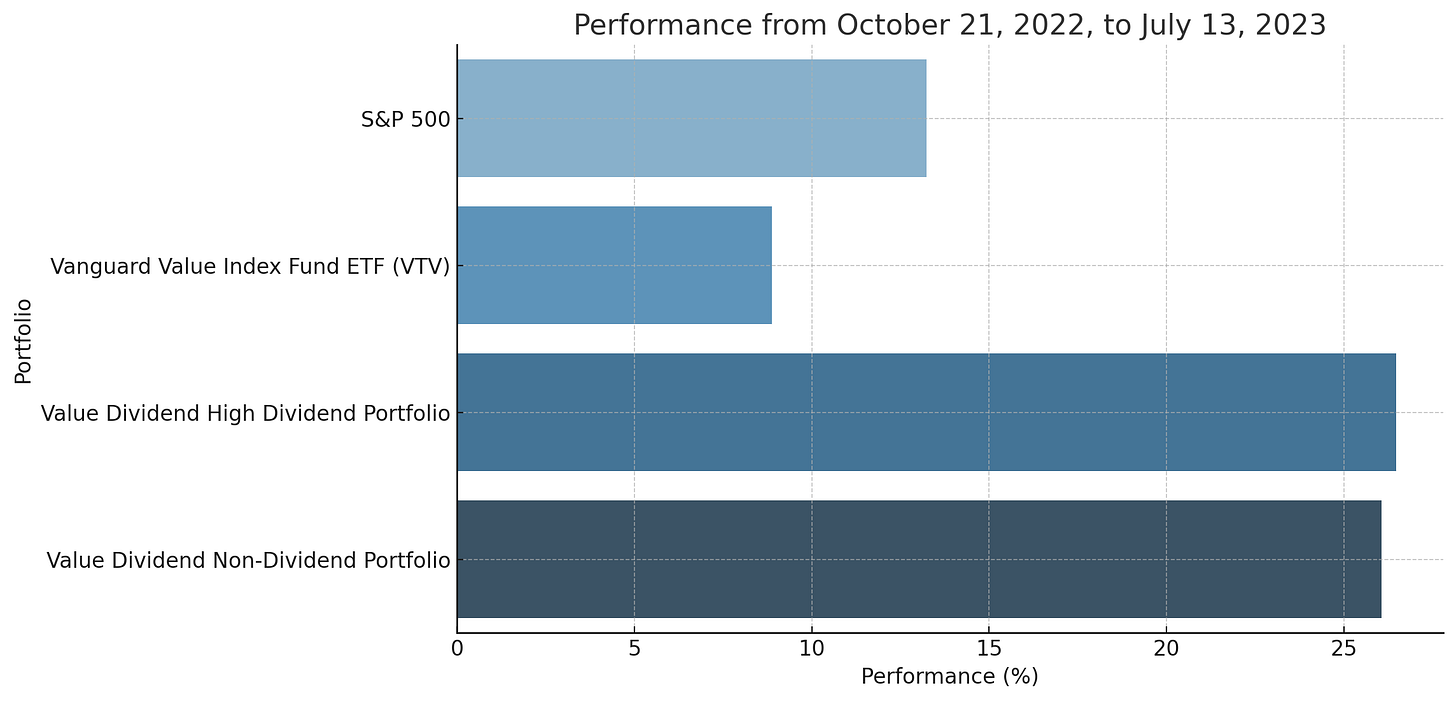
As I am writing this, the overall performance since creation of the portfolio is 26.48% excluding paid-out dividends.
The average dividend yield of this portfolio was 4.2% at the date of creation.
The average performance of 26% comes with a standard deviation of 31%. The highest performance showed InterDigital Inc. (IDCC) with 104% while Valero Energy Corp (VLO) performed worse with -8% – simultaneously VLO was the only stock in this portfolio with a negative performance.
The average dividend yield is approximately 4.19%, with a standard deviation of 1.84%. This indicates a wide range of dividend yields among the companies, with a maximum yield of 8.98%.
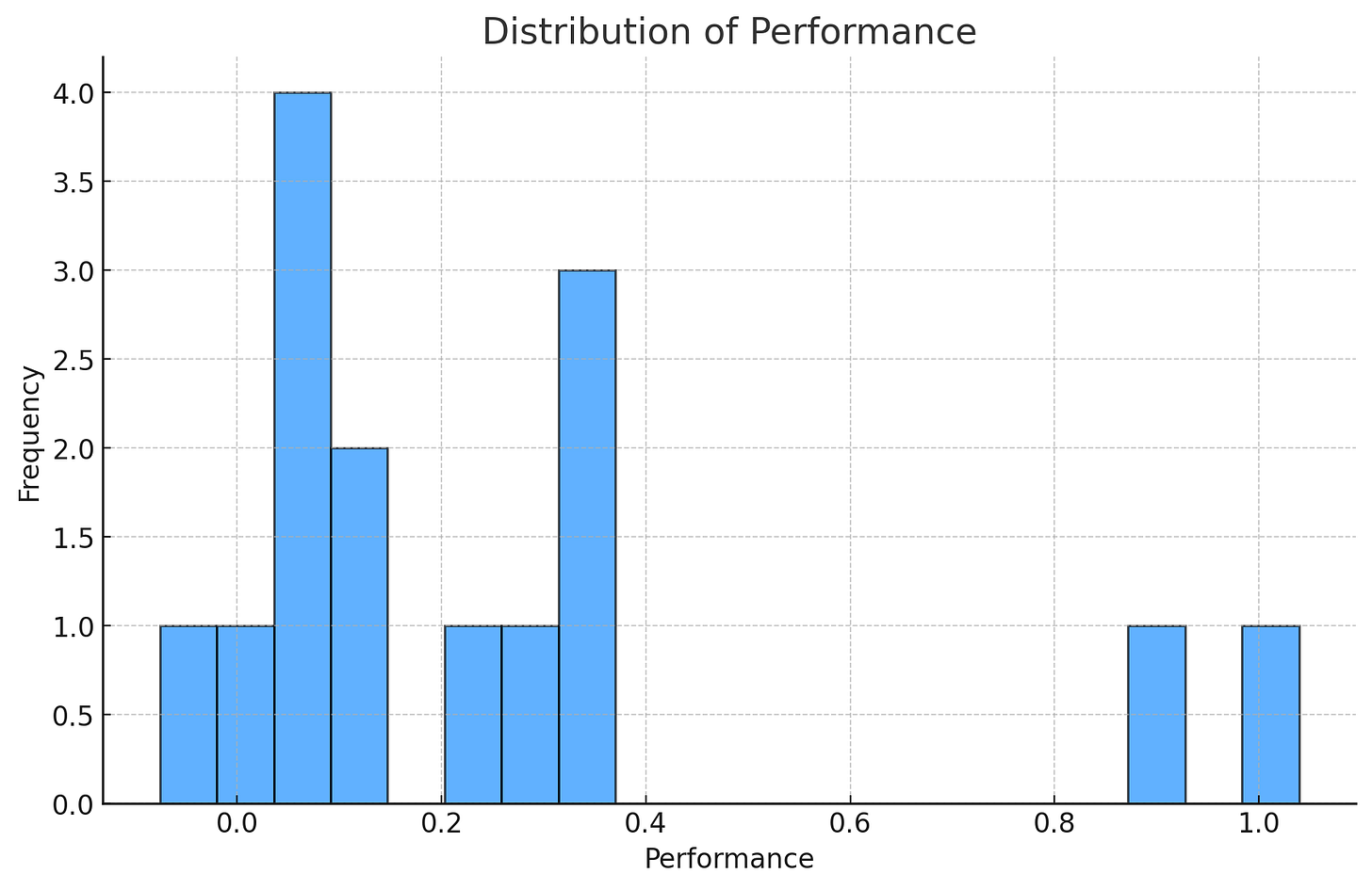
When we look at the distribution of stock performance, we can see that most of the stocks have gained between 0% and 40% with two notable exceptions exhibiting a much higher performance.
When we look at the correlation between performance and dividend yield, we can see a moderate positive correlation. This suggests that higher-performing stocks also tended to have higher dividend yields, which proves the point of The Value Dividend Strategy.
Top 5 Performers of the Value Dividend High Dividend Portfolio:
InterDigital Inc IDCC with a gain of 104%
Patrick Industries Inc PATK with a gain of 91%
LCI Industries Inc LCII with a gain of 35%
Ingredion Inc INGR with a gain of 34%
Celanese Corp CE with a gain of 32%
Hypothetically, by investing in these five stocks, one could’ve achieved a return of 59% with – important to note – value stocks.
Bottom 5 Performers of the Value Dividend High Dividend Portfolio:
Valero Energy Corp VLO with a loss of 7.6%
Exxon Mobil Corp XOM with a gain of 2%
Phillips 66 PSX with a gain of 4%
Global Partners LP GLP with a gain of 8%
Huntsman Corp HUN with a gain of 9%
As we can see, particularly VLO has been a bad pick. The question is not why VLO had been a bad pick, but how we can avoid picking losers in the future altogether. I want to answer this question in this continuous newsletter by through deep dives, not only in promising Value Dividend stocks but also into suspicious ones and perform a due diligence, valuation, and margin-of-safety calculations. If you haven’t already, I welcome you to subscribe!
Performance of the Non-Dividend Portfolio
The Value Dividend portfolio which paid no dividends consisted of 21 stocks.
As I am writing this, the overall performance since creation of the portfolio is 26.06%.
In the Value Dividend portfolio which pays no dividends, the average performance was 26% with a standard deviation of 47%. This standard deviation is quite high, as some stocks performed exceptionally well (155.79%) while others showed high losses (-46.18%).
Looking at the distribution of returns, we see that most of the stocks in the Non-Dividend portfolio show returns of 0 to 60% with a few notable exceptions exhibiting much higher or lower performance.
This was to be expected, as I observed similar high standard deviations during my study of Value Dividend stocks. Yet, as we can see, with a performance of 26% of the overall portfolio we still achieved higher returns than the S&P 500, which gained 13.23% over the same period of time.
When we look at correlations, it may be worth noting that there is a moderate negative correlation between performance and P/B ratios. Stocks with a higher performance had lower P/B ratios which may be because they were undervalued.
Top 5 Performers of the Value Dividend Non-Dividend Portfolio:
Builders FirstSource Inc BLDR with a gain of 156%
AutoNation Inc AN with a gain of 86%
Asbury Automative Group Inc ABG with a gain of 78%
GMS Inc GMS with a gain of 70%
US Goods Holding Corp USFD with a gain of 62%
Hypothetically, investing in these 5 Value Dividend stocks would’ve resulted in a 90% gain with low P/B stocks.
With non-dividend paying value stocks, the challenge is to weed out the bad performers, while focussing on the high performers.
Bottom 5 Performers of the Value Dividend Non-Dividend Portfolio:
United Natural Foods Inc UNFI with a loss of 46%
Ascent Industries Co ACNT with a loss of 37%
Stride Inc LRN with a loss of 20%
TrueBlue Inc TBI with a loss of 18%
DLH Holdings Corp DLHC with a loss of 17%
By looking at the bottom performers, it becomes clear how risky this strategy can be, if focussed on the wrong stocks and if one avoids diversification. With diversification, the overall portfolio nevertheless gained 26% – despite having several double-digit loss stocks in the portfolio.
As part of this ongoing Value & Dividends newsletter, I will dive deep into individual non-dividend paying stocks, to learn how we can promptly avoid investing in these losers stocks.
To set these performances in perspective: Over the same period of time, from October 21, 2022, to today, the S&P 500 gained 13.23% and the Vanguard Value Index Fund ETF (VTV) gained 8.88%. Thereby, both Value Dividend portfolios outperformed the index and the overall value index.
If you want to learn more on how I discovered this strategy and how the portfolios were created, you can read my book online or order a copy from amazon.com.
Résumé
Since publishing my book The Value Dividend Strategy, we can see that Value Dividend portfolios still outperform the index and large diversified value portfolio. With this newsletter and blog, I will continuously update, refine, and expand The Value Dividend Strategy. I will dive deep into selected promising or suspect Value Dividend stocks to find clear winners and loser within the small range of Value Dividend stocks.
Furthermore, I’ve been majorly invested in Palantir PLTR which does not fulfill Value Dividend criteria per se, but which was a stock clearly undervalued in 2022 and gained in 100% since October 21st 2022. As soon I detect other unique undervalued growth stocks, they will also have their place in Value & Dividends.
In combination with critical macroeconomic analysis, I aim to provide real value and real dividends to readers of this newsletter.
If you haven’t already – I invite you to join the Value & Dividends community and I appreciate your subscription to this publication.
The content provided in this newsletter is for informational purposes only. The information, analysis, and opinions expressed herein are solely those of Marius Schober and do not represent, reflect or express the views of any other person or entity.
This newsletter does not constitute investment advice, financial advice, trading advice, or any other sort of advice, and you should not treat any of the newsletter’s content as such. Marius Schober does not recommend that any securities, transactions, or investment strategies mentioned in this newsletter are suitable for any specific person.
The information provided in this newsletter is obtained from sources believed to be reliable, but Marius Schober does not guarantee its completeness or accuracy, or warrant its completeness or accuracy. Readers are urged to consult with their own independent financial advisors with respect to any investment.
All information and content in this newsletter are subject to change without notice. Prices, quotes, and other financial information may be out of date or inaccurate. Past performance is not indicative of future results. Investing in securities involves risks, including the potential loss of all amounts invested.
Marius Schober does not accept any liability for any loss or damage which is incurred from you acting or not acting as a result of reading any of our publications. You acknowledge that you use the information we provide at your own risk.
By subscribing to this newsletter, you acknowledge and agree to the terms of this disclaimer.
For at least two decades, we have not seen any real progress. Not in science, not in business, not in our real world.
In order to unlock the secrets that lie beyond Einstein’s theory, delve into the mysteries of UFOs, explore the feasibility of space travel, harness free abundant energy, and achieve global peace, we must explore alternative approaches.
I believe this approach does not start with science but with consciousness.
I believe that we can solve our world’s greatest challenges and solve the universe biggest enigmas by using, accessing, and expanding our human consciousness.
When we collectively expand our consciousness, we will achieve a quantum leap as a human species.
Seit mindestens zwei Jahrzehnten haben wir keinen wirklichen Fortschritt mehr gesehen. Nicht in der Wissenschaft, nicht in der Wirtschaft, nicht in unserer realen Welt.
Um die Geheimnisse jenseits der Einsteinschen Theorie zu lüften, die Mysterien der UFOs zu ergründen, die Machbarkeit der Raumfahrt zu erforschen, freie, reichlich vorhandene Energie nutzbar zu machen und globalen Frieden zu erreichen, müssen wir alternative Ansätze erkunden.
Ich glaube, dass dieser Ansatz nicht bei der Wissenschaft, sondern beim Bewusstsein ansetzt.
Ich glaube, dass wir die größten Herausforderungen unserer Welt und die größten Rätsel des Universums lösen können, indem wir unser menschliches Bewusstsein nutzen, darauf zugreifen und es erweitern.
Wenn wir unser Bewusstsein kollektiv erweitern, werden wir als menschliche Spezies einen Quantensprung machen.
Der Weg zum Fortschritt führt über das Bewusstsein.